Adaptive Flow Delivery
The first methodology
for the AI era.
The first delivery methodology built from the ground up for the AI era. Seven phases, six Confidence Gates, one principle — resolve uncertainty through analysis, then build the right thing once, with confidence.
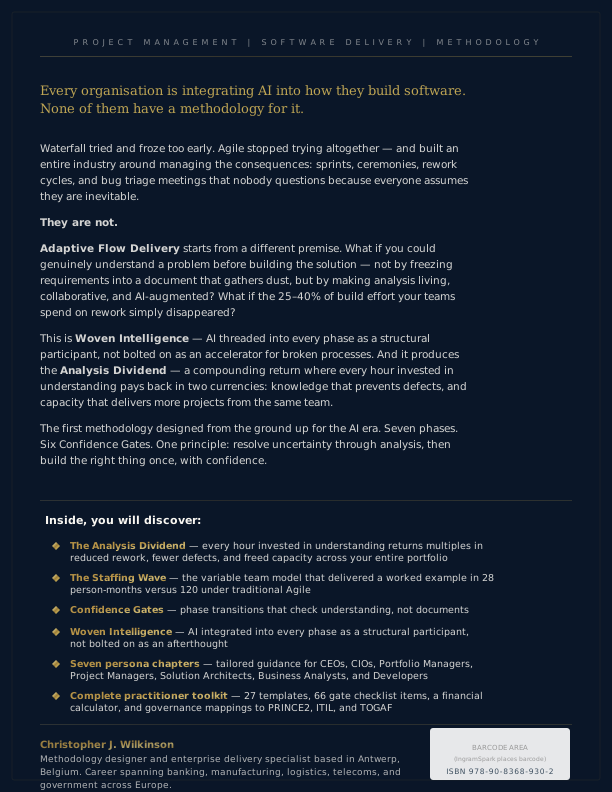
 Adaptive Flow Delivery — full cover
 The Method
Seven phases. One continuous discipline.
From Discover to Continuous, every phase ends at a Confidence Gate — a question you must answer before you're allowed to proceed.
Discover
Frame the problem space
Discover frames the problem space without committing to a solution. Three artefacts are produced — the Brief, the Stakeholder Map, and the Constraint Register — each of which lives across the rest of the programme.
Define
Crystallise the right problem
Define is the phase Agile shorthands away. AFD insists on a written, signed Problem Statement that names the gap, the audience, and the falsifiable success criteria. This is the phase the Analysis Dividend is paid into.
Design
Resolve the solution shape
Design resolves the shape of the solution against the Problem Statement. Architecture, data flow, persona-aware UX, dependency map. Confidence Gate 3 is the last cheap moment to change your mind.
Build
The Quiet Build
Build is the Quiet Build. The team grows briefly, executes against decisions already taken, and shrinks again. Drift is recorded against the design intent rather than absorbed into the next sprint.
Validate
Prove it against intent
Validate proves the artefact behaves as the Problem Statement said it should. Telemetry, dry-runs, hand-back loops to design when reality refuses the design. Confidence Gate 5 confirms operational readiness.
Deliver
Hand over to operations
Deliver hands the artefact to operations with the run-book, the on-call rota, the success criteria still attached. The day-of-launch is the dullest day of an AFD programme.
Continuous
Sustain and improve
Continuous keeps the artefact alive — observed, governed, and re-discovered when its environment changes. The phase that closes the loop back to Discover.
Problem-fit
“After Discover. Have we framed the right problem space?”
Pass requires the Problem Brief.
Definition lock
“After Define. Is the Problem Statement falsifiable?”
Pass requires the Definition Dossier.
Solution shape
“After Design. Are the dependencies, constraints, and tradeoffs explicit?”
Pass requires the Design Record.
Build faithfulness
“After Build. Is the artefact faithful to the design intent?”
Pass requires the Build Manifest.
Operational readiness
“After Validate. Will operations be able to run this on day one?”
Pass requires the Validation Report.
Continuous handoff
“After Deliver. Has Continuous taken the watch?”
Pass requires the Handover Pack.
From the book
Three ideas that change how you deliver.
Knowledge leaks at every boundary
Every time understanding passes between people, 10–30% is lost. Four handoffs, and your testers are building against a quarter of the original intent.
Waterfall froze it. Agile abandoned it.
Waterfall froze understanding too early. Agile abandoned it altogether. Both leave the same gap — no mechanism to turn analysis into momentum.
The cheapest time you'll ever spend
Rigour up front isn't bureaucracy. It's the cheapest time you'll ever spend — and the dividend compounds every phase after.
From the Institute
News & upcoming events.
Latest news
All news eu-ai-act
 Nobody called it an AI project
Most software is untouched by the EU AI Act — and the things that do cross the line are rarely the ones anyone labelled an AI project. A plain-English guide to who it applies to, what the deferral actually changed, and why bolted-on AI widens the gap.
Read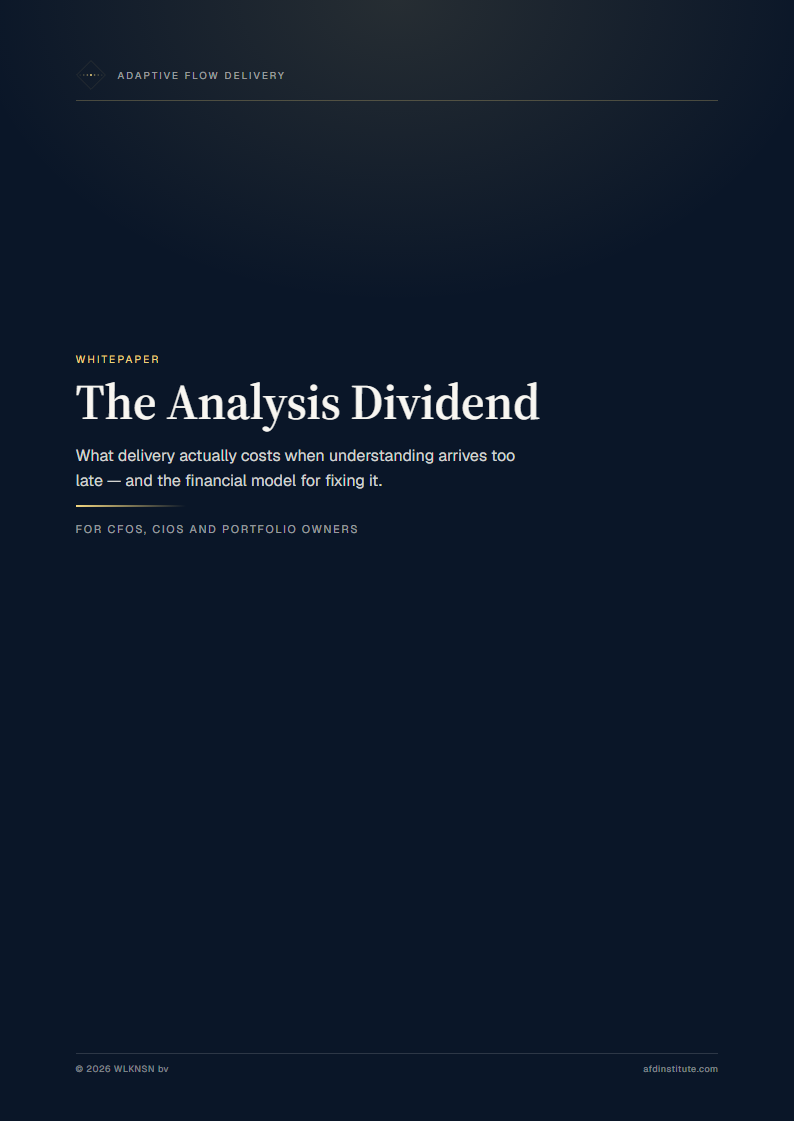 whitepaper
 The Analysis Dividend: a ten-page answer to the fairest question in delivery
A free ten-page whitepaper on what delivery costs when understanding arrives too late — defect economics, a worked 200-requirement example, a EUR 500,000 project modelled two ways, and four cases where the maths does not work.
ReadAdaptive Flow Delivery Is Here: Turning AI's Speed Into Delivery That Compounds
The book is available now on Amazon. AI made building almost free — here's how Adaptive Flow Delivery turns that speed into delivery that compounds instead of evaporates.
Read